
A marina schedule is part of the calculation record
For marina shore-power work, the schedule often has to communicate more than a conventional circuit directory. Pedestal feeders can represent multiple receptacles, repeated circuit IDs can identify looped pedestals, conductor sizing can be affected by demand and voltage drop, and boat-lift loads may require separate branch and upstream feeder review.
The schedule is most useful when it is generated from the same data used for the demand calculation. That connection reduces the risk that a revised receptacle layout changes the demand total while an older breaker, conductor, or distance remains in a separate spreadsheet.
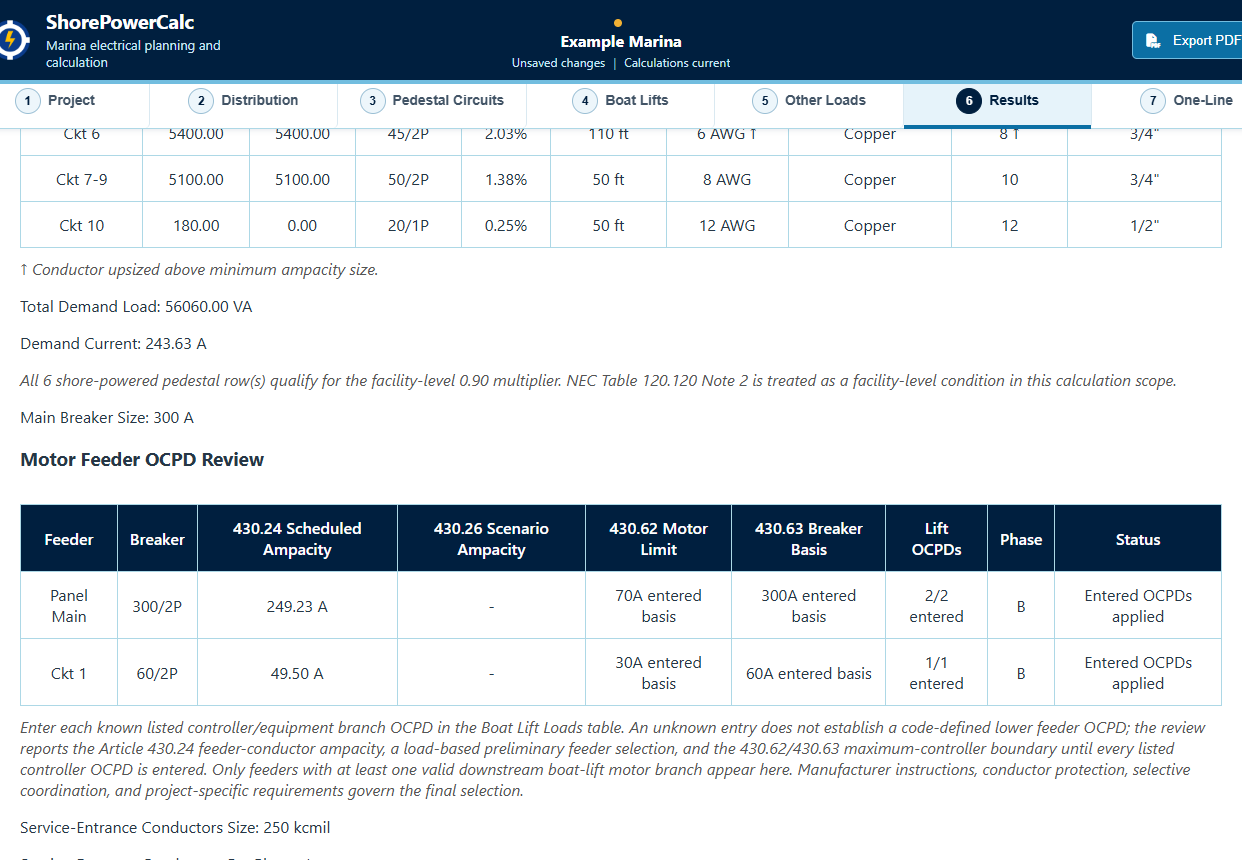
Core information for each marina feeder circuit
The exact schedule format depends on the project and selected distribution mode, but each calculated circuit row should preserve enough information to identify and review the result.
Circuit identity
Use a stable circuit ID that matches the pedestal input, one-line branch, report notes, and saved project. If multiple pedestal rows are intentionally looped on one feeder, the repeated ID and loop count should be visible in the related project information.
Calculated load by phase or leg
Show the calculated VA or kVA contribution in a way that supports phase-loading review. For a three-phase source, phase assignment and imbalance become important upstream checks. For single-phase systems with 120V loads, the leg assignment should remain traceable.
Breaker or overcurrent result
Display the selected or calculated breaker value and pole configuration. Where a motor-feeder value is preliminary or depends on the actual listed controller OCPD, the schedule or report should say so instead of implying that an unresolved value is final.
Distance and voltage drop
Keep the entered distance beside the voltage-drop result. For a looped feeder, distinguish a source-to-first-pedestal run from subsequent spans and the total evaluated run. A percentage without the distance convention is difficult to audit later.
Phase conductor and material
Report conductor size, material, and any parallel-set notation clearly. The result should remain tied to the selected wiring method, ampacity assumptions, adjustment or correction factors, termination basis, and project-specific review requirements.
Equipment grounding conductor
Show the calculated EGC separately from the phase-conductor result. Where phase conductors are increased, verify the applicable grounding-conductor treatment and confirm the actual equipment and installation requirements.
Raceway or cable result
If the project uses a raceway method, show the trade size and parallel raceway count in an unambiguous format. If it uses a cable assembly, identify that raceway fill is not being reported as though the circuit were individual conductors in PVC.
Consistency check: The circuit ID, load, breaker, conductor, EGC, raceway, distance, and voltage-drop result should agree across the input table, schedule, one-line, and exported PDF.
Schedule-level summaries matter
Individual circuit rows are only part of the panel review. A marina panel schedule should also provide a clear summary of the calculated panel or feeder basis, such as:
- Total qualifying shore-power receptacle count and demand factor.
- Total calculated demand and current.
- Main breaker or service size.
- Service or feeder conductor result and raceway arrangement.
- Phase loading and imbalance where applicable.
- Grounding electrode conductor or equipment grounding information appropriate to the calculation boundary.
- Warnings, demand-reduction notes, simultaneous-operation assumptions, and unresolved equipment inputs.
On a Multi Panel Marina project, include both the downstream dock-panel schedules and an upstream MDP feeder schedule. On a Large MDP & Substation project, keep primary substation feeders and downstream pedestal-panel schedules distinct.
Boat-lift schedules require their own context
A boat-lift motor branch is not fully described by placing its horsepower beside a general feeder row. The project may need a separate motor-load schedule showing motor FLC basis, branch-conductor planning, controller-to-motor conductor information, actual or calculated controller OCPD, EGC, voltage drop, and the upstream motor-feeder review.
Where a lift shares a slip with shore power, the marina demand calculation and the actual motor branch are related but not identical. The report should make both visible.
The one-line should confirm the schedule
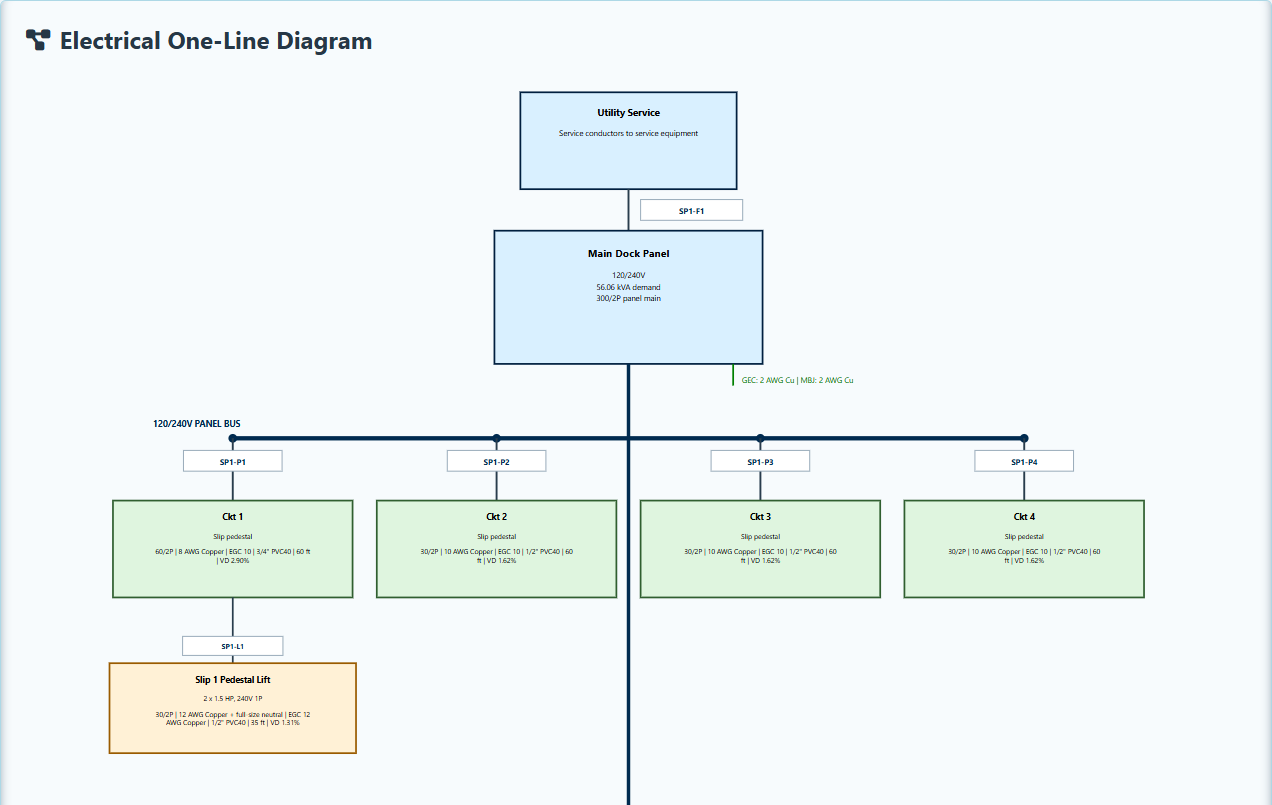
A schedule is easier to review when the one-line uses the same panel names, circuit IDs, breakers, conductor notes, and distribution hierarchy. If a dock panel, pedestal loop, boat lift, or substation appears in one output but not the other, the project needs another review before it is relied upon.
What a panel schedule calculator cannot decide
No automated schedule can resolve every field condition, equipment listing, local amendment, termination limitation, ground-fault requirement, grounding and bonding detail, available fault current, selective-coordination issue, utility rule, or AHJ interpretation. It also cannot convert planning-level calculation output into a sealed design.
Use the calculated schedule as an organized review aid. Compare it against the adopted code, actual equipment, manufacturer information, project specifications, field routing, utility requirements, and professional engineering decisions.
ShorePowerCalc output is not a construction document. It must be independently reviewed and approved before permitting, procurement, installation, or energizing.